
You have accepted the job, started planning the move and perhaps already pictured yourself cycling to work like a local.
Then comes the slightly less romantic part: finding somewhere to live.
Renting in the Netherlands as an expat can feel confusing at first. There are different types of rental housing, landlords may ask for documents you have never needed before, and the best way to search can depend heavily on your income, location, moving date and personal situation.
The good news? Once you understand how the Dutch rental process works, it becomes much easier to know what to prepare and what to look out for.
Here is where to start.
Step 1: Know what you are looking for
Before opening ten rental websites and saving every apartment with a nice kitchen, it helps to define what you actually need.
Start with the basics: your maximum monthly budget, preferred location, commuting distance, number of bedrooms and moving date. Then think about things that are particularly relevant when renting in the Netherlands, such as whether you need the property furnished and whether you need to register at the address.
Also consider how flexible you are.
Could you live 20 or 30 minutes outside your preferred city? Would an apartment work just as well as a house? Do you need furniture, or would a semi-furnished property be enough?
These details matter because there is no single rental route that works equally well for everyone. Someone moving to the Netherlands for a two-year assignment may be looking at a very different part of the market from someone planning to stay long term.
Knowing your own situation first can save you a lot of scrolling later.
Step 2: Understand the Dutch rental market
One thing that can make the Dutch rental market confusing for newcomers is that not every home falls under the same rules.
You may come across terms such as social housing, mid-priced rental housing and private-sector rental housing. Different conditions, rent rules and eligibility requirements can apply depending on the type of property.
You do not need to become an expert in Dutch housing legislation before starting your search.
But it does help to understand that seeing a home online does not automatically mean it fits your situation. Income requirements, availability, eligibility criteria and landlord preferences can all play a role.
For internationals, knowing which part of the market is relevant to their situation can make the search much more focused.
Step 3: Get your documents ready
Found a home you like? Things can move quickly from there.
Landlords and rental agencies will usually want to know whether you can afford the rent. Depending on the property and your situation, you may be asked for documents such as:
- proof of identity
- an employment contract
- recent payslips
- an employer’s statement
- other proof of income
If you have only just started a job in the Netherlands, your situation may look slightly different. You might not have Dutch payslips yet, for example, or your employment contract may only start after your planned move.
That does not automatically mean you cannot rent a home. It simply means it is useful to know which documents you already have and which ones you can obtain before applying.
Having everything ready also makes it much easier to respond quickly when the right property appears.
Step 4: Start searching — but choose your route carefully
This is where most people head straight to Google.
And yes, there are plenty of places to look.
Rental homes in the Netherlands are offered through a mix of rental platforms, housing organisations, letting agencies and professional housing or relocation services.
The important thing is that not every search route works equally well for every renter.
Some options may focus on a certain price range, region or type of housing. Others may offer more personal support during the search. Your budget, income, preferred location, rental period and how much help you need can all influence which route makes the most sense.
A platform that works perfectly for one international may be far less useful for another.
So instead of creating an account everywhere at once, it is worth first understanding what kind of search actually fits your situation.
Step 5: Look beyond the monthly price
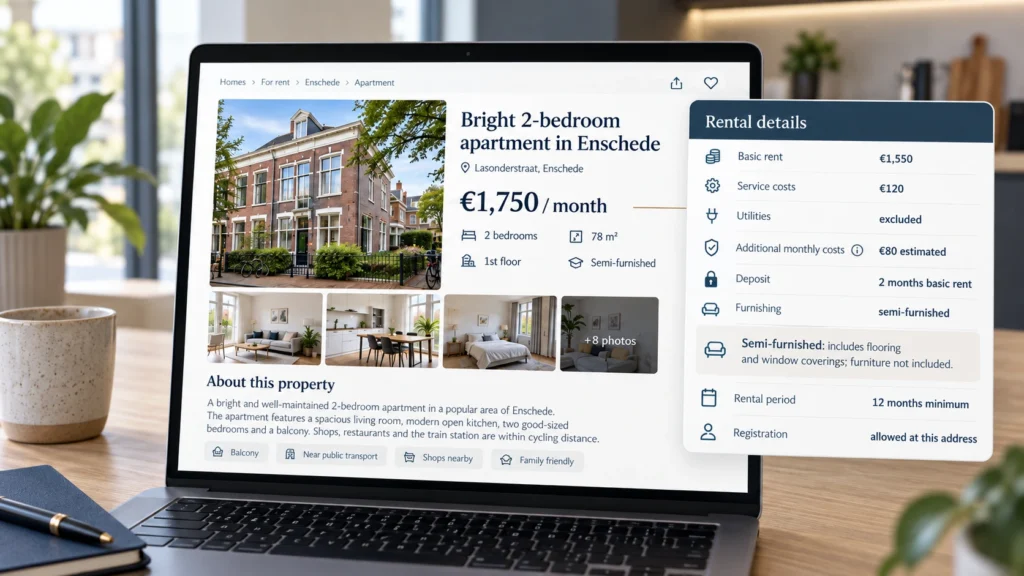
You find an apartment for €1,750 per month. Perfectly within budget.
Or is it?
When reading a Dutch rental listing, check what is actually included in the advertised price. The basic rent may be separate from service costs, utilities or other monthly charges.
Also pay attention to:
- the deposit
- whether the property is furnished or semi-furnished
- the rental period
- whether registration at the address is possible
- any additional monthly costs
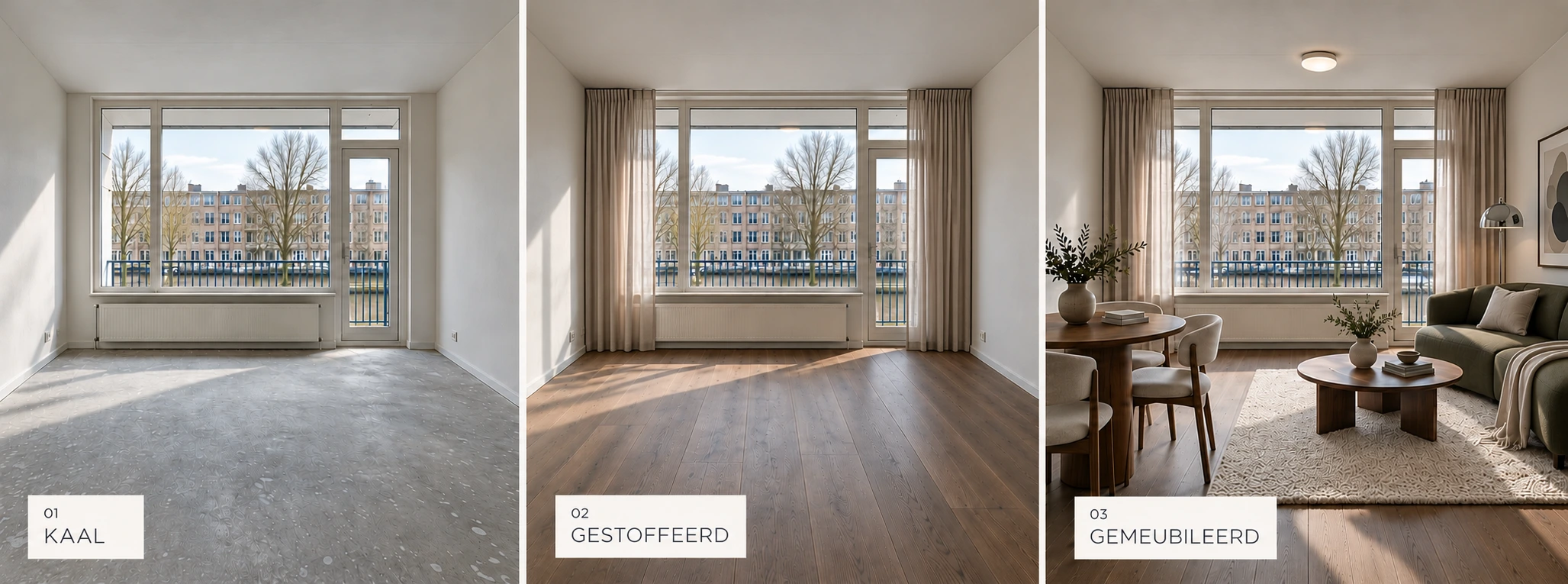
Dutch rental listings may use words such as gestoffeerd and gemeubileerd. A semi-furnished property may include flooring and window coverings, for example, without including the furniture you would expect from a fully furnished home.
The headline price is therefore only one part of the picture.
Step 6: Be ready for the viewing and application
A viewing is your chance to see whether the home actually matches the listing.
Look beyond whether you like the kitchen or sofa. Pay attention to the condition of the property, natural light, storage, the neighbourhood and practical things such as parking or public transport.
Still abroad? It can be worth asking whether a video viewing or another form of remote viewing is possible.
If you decide to apply afterwards, being prepared helps. In popular parts of the rental market, several candidates may be interested in the same property.
That is when having your wishes and documents ready becomes especially useful.
Step 7: Check before you sign
Getting offered a home is exciting, especially after a long search.
Still, this is not the moment to skip the small print.
Check the rent, additional costs, deposit, starting date and rental period carefully. Also look at what is included with the property and what the agreement says about ending the tenancy.
If anything is unclear, ask before you sign.
It is much easier to sort out questions while you are still reading the contract than once the moving boxes are already inside.
Step 8: Do not forget registration after your move
Keys collected, boxes everywhere, first trip to the supermarket completed.
Almost there.
If you are moving to the Netherlands for a longer period, registering with your municipality is usually one of the important next steps. This is also how you receive your BSN, or citizen service number, which you will need for many practical parts of living in the Netherlands.
It may not be the most exciting part of the move, but it is one you do not want to forget.
There is no single best way to rent in the Netherlands
The general process of renting a home in the Netherlands as an expat may look similar for most people: decide what you need, understand the market, prepare your documents, search, view, apply and sign.
But the route between those steps can be very different.
Your budget, salary, employment contract, preferred region, moving date and length of stay can all influence which options are realistic — and where it makes sense to spend your time searching.
That is why a good rental search does not necessarily start with finding as many properties as possible.
It starts with understanding your own rental situation.