This platform makes sure you can reply on properties in the Netherlands and get in touch with the landlord or letting agent.
Author: Lauren David Richard
-
Furnished or unfurnished? What’s included in a Dutch rental?
Choosing between a furnished or unfurnished rental in the Netherlands? The difference goes beyond whether you need to bring a sofa. Flooring, curtains and appliances can vary too—and the photos do not always show what will stay…
Table of Contents
What do the Dutch furnishing terms mean?
English translations vary between advertisements. “Unfurnished” can be particularly confusing, so check the Dutch term alongside the property description.
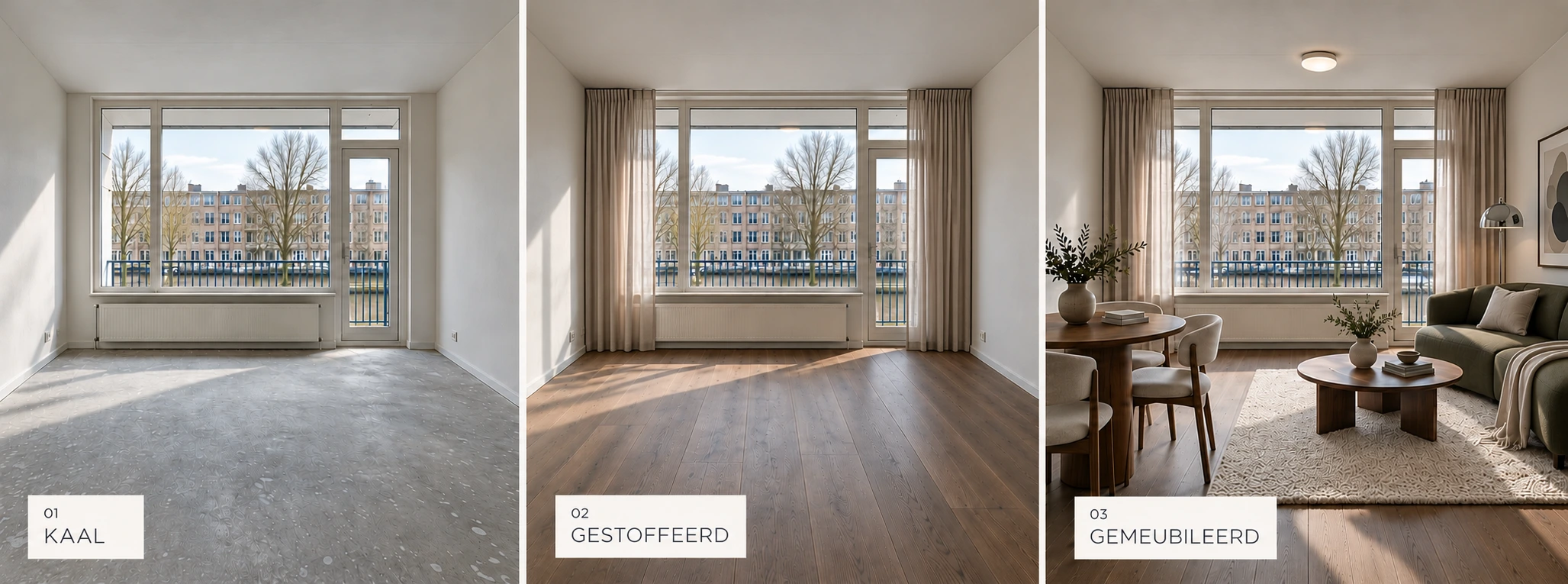
Kaal: a shell rental
A kale woning comes without furniture and may also lack floor coverings, curtains and light fittings. Check the kitchen separately: having a kitchen does not tell you which appliances are included.
You may need to arrange flooring before bringing in your furniture. Ask about the condition expected when you leave, too; items you install cannot necessarily remain for the next tenant.
Gestoffeerd: semi-furnished or upholstered
A gestoffeerde woning generally includes basic finishing, such as flooring, but no movable furniture. Curtains and lighting are commonly associated with this category, although advertisements do not always use the term consistently.
You will usually need your own bed, sofa and table. Check window coverings and appliances individually, especially a washing machine or dryer.
Gemeubileerd: furnished
A gemeubileerde woning includes furniture, but the exact inventory varies.
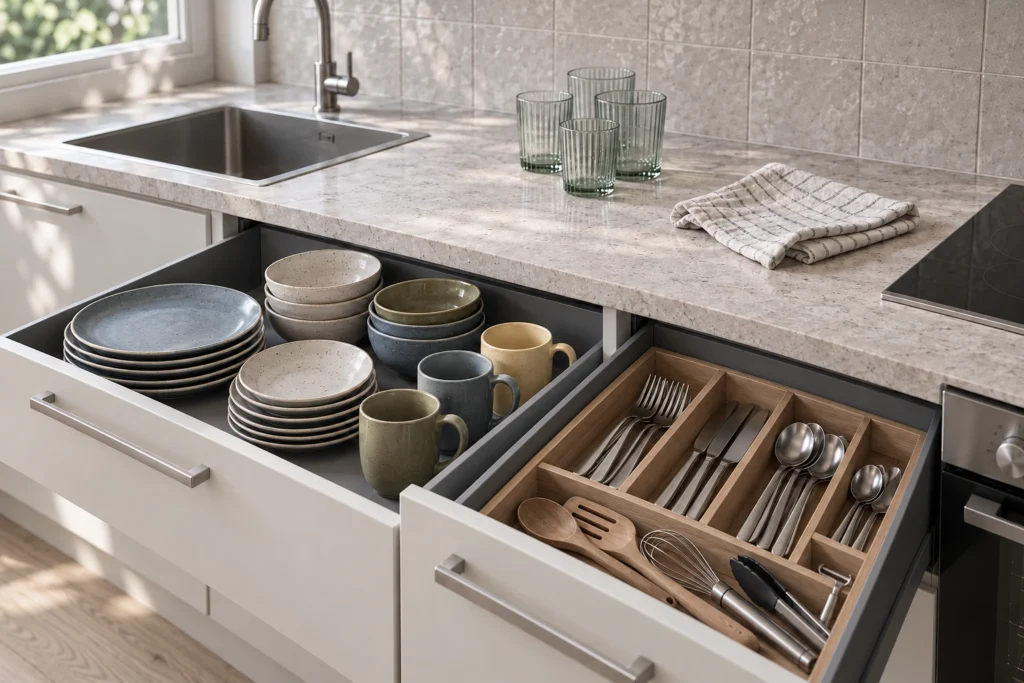
Some properties are set up for international tenants to arrive with little more than a suitcase. Others provide the main furniture but leave you to arrange bedding, towels, crockery and cooking equipment.
Whether you choose furnished or unfurnished accommodation, ask for a written overview of what will be included.
For an additional explanation of the terminology, see Huurwoningen.nl’s guide to shell, semi-furnished and furnished rentals (in Dutch).
Photos show what is there, not necessarily what stays
If a property is still occupied, items visible during a viewing may belong to the outgoing tenant. Even a furnished rental can be advertised with older photographs that no longer match the interior.
For example, a washing machine and dryer might be present during your viewing but leave with the tenant before you move in. This is a possible scenario, not something the furnishing label alone can resolve.
Instead of asking whether the property “has” a washing machine, ask:
“Will this washing machine remain, and is it included in the rental?”
Have important details confirmed in writing before signing. If the advertisement and the information given during the viewing differ, ask which items will actually be supplied.
What if the previous tenant offers to leave things behind?
The outgoing tenant may offer to sell you items such as flooring, curtains or appliances. This is often called overname.
Available items and prices may be discussed during the viewing, either by the tenant or through the rental agent. The agent may then help both tenants get in contact, leaving them to arrange the purchase directly.
Before agreeing, establish:
- Exactly which items are being sold and their condition.
- The price, payment arrangements and handover date.
- Whether they belong to the tenant or are already included in the rental.
- Whether the landlord agrees that they can remain, particularly flooring or fitted items.
Keep the arrangement in writing. Items you purchase from a tenant should be clearly distinguished from items supplied by the landlord.
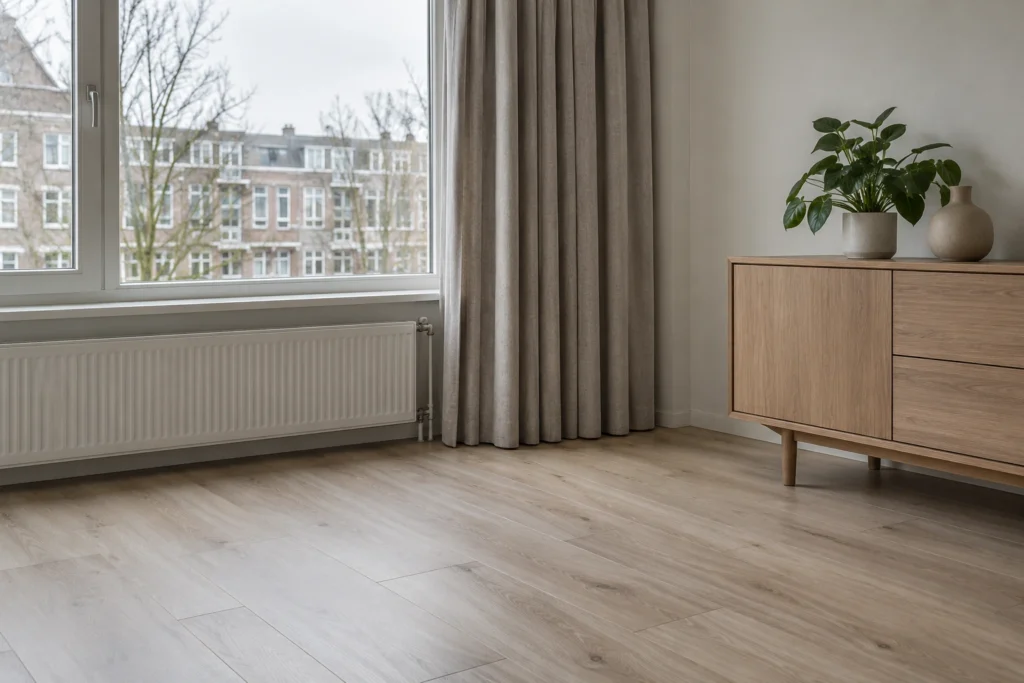
Furnished or unfurnished: which option fits your stay?
A shorter stay with a planned return home
A furnished property can save you from buying, transporting and later selling a household’s worth of furniture.
If you expect to stay for around a year, arranging flooring for a shell rental may be more work than you want to take on. A furnished home can simplify your arrival, provided its inventory meets your needs.
A longer stay
A shell or semi-furnished home may suit you if you want to settle in and use your own furniture.
Semi-furnished can be a useful middle ground: some basic finishing is already there, while you choose the furniture. Bringing belongings from abroad may also become more worthwhile over a longer stay, depending on transport costs and whether they fit the property.
Plans that are still uncertain
Compare actual homes rather than assuming one furnishing category always offers better value.
Consider the monthly rent, any separate furnishing charges, setup costs and the work involved when you leave. Also distinguish money needed upfront from costs over your stay. Furniture you buy may move with you or have resale value, although you should not count on recovering the full purchase price.
Whether furnished or unfurnished housing offers better value depends on your length of stay and what you already own.
Time matters too. Shopping for appliances and arranging deliveries can be difficult when you are starting a new job immediately after arrival.
Your checklist before signing
Before signing for a furnished or unfurnished rental, confirm which items will remain and which you need to arrange yourself.
Item What to confirm Flooring Which rooms have floor coverings? Is any flooring offered separately for takeover? Curtains and blinds Which window coverings will remain? Furniture Which pieces are included, and do they match the photos? Kitchen appliances Which appliances are supplied with the property? Laundry appliances Are a washing machine and dryer included? Everyday essentials Are bedding, towels, dishes and cookware provided? Takeover items What requires a separate purchase from the outgoing tenant? At the key handover, compare the property with the agreed inventory. Record missing items or existing damage in the inspection report, with supporting photos.
Choose a home that fits how you are moving
Moving for a year with two suitcases calls for a different setup from relocating with your own furniture and plans to settle.
Use your expected stay, available budget and willingness to organise the setup to decide which furnishing options belong in your search. Then check each property on its own details.
Need help deciding where to start your housing search?
Find your route → to explore a rental route based on your budget, location and personal situation.
-

Rental Application: 7 Simple Tips to Apply Confidently in the Netherlands
You find a home that looks promising. The location works for your commute, the rent fits your budget, and there is even a second bedroom that could become your home office.
Time to contact the rental agent.
But what do you actually write?
The good news is that a strong rental application does not need to be complicated. A friendly introduction, clear information and a little preparation can help the agent understand your situation.
Think of it as introducing yourself before you have had the chance to meet.
Here are seven practical tips to help you apply with confidence.
Table of Contents
1. Make your message specific to the property
When you are responding to several homes, having a basic introduction ready can save plenty of time.
Keep the parts about your work and household, then adapt the details to the property you are applying for.
Mention the correct address and city, and briefly explain why the home interests you. Perhaps it is close to your new workplace, the layout suits your household or the available starting date fits your move.
You do not need to write a love letter to the kitchen. One genuine reason is enough.
Before sending your rental application, take a moment to check that the details match the listing.
An enthusiastic message about wanting to live in Zwolle makes much more sense when the property is actually in Zwolle, rather than Enschede.
It is a small check, but it helps your message feel personal and considered.
2. Introduce everyone who would live there
A useful introduction starts with your household.
State how many people would live in the property and how your household is made up. You might be moving alone, with a partner, with children or with a friend.
For example:
“We are a couple moving to the Netherlands for work. The property would be occupied by the two of us.”
Or:
“We are a family of four: two adults and our two children.”
This gives the agent a clear starting point and helps them assess whether the property and its occupancy conditions suit your situation.
Next, explain what you do for work and include your gross monthly income: the amount before tax and other deductions.
If you are applying together, give each applicant’s income separately and then the combined total:
“I earn €3,500 gross per month, and my partner earns €3,000 gross per month. Our combined gross monthly income is €6,500.”
This is clearer than simply saying “our income is €6,500”. The agent can immediately see which period and type of income you mean.
How combined incomes are assessed may differ between landlords, so check the conditions of the particular property.
Finally, include your preferred moving date.
With those details, your rental application already answers several important questions: who is moving in, what your employment and income situation looks like, and when you would like to move.
3. Use the listing to guide your application
A rental listing can help you decide what to include in your response.
Before you apply, look at:
- The available starting date.
- The rent and additional costs.
- Any stated income requirements.
- The occupancy conditions.
- Whether the property is furnished.
- The instructions for requesting a viewing.
If the home appears to fit your situation, explain that briefly.
For example:
“The advertised starting date of 1 November works well with the start of my new job.”
If something needs clarification, ask a specific question:
“The listing mentions service costs. Could you confirm whether heating is included?”
You do not have to know everything before contacting the agent. A relevant question can help you work out whether the property is right for you.
The aim is to make your first conversation useful for both sides.
4. Prepare your rental application documents
Having your documents organised can make the next stage feel much more manageable.
For applicants in employment, documents requested during screening may include the following:
Recent payslips
Often, agents request payslips from the latest three months. Check which period is needed for your application.
Evidence of salary payments
You may be asked for relevant bank records showing the salary deposits that correspond to your payslips.
An employer’s statement
You can request this from your employer or HR department. It provides information about your employment situation. If the agent uses a particular form, check this before asking your employer to complete it.
Your employment contract
Some agents request this as additional evidence of your employment and income.
A short introduction letter
This can bring together your household details, work, moving plans and reason for applying. It does not need to be long; a few relevant paragraphs can give a clear picture.
The exact documents depend on the agent, landlord and your circumstances. Treat this as a preparation list rather than a checklist that applies to every property.
What if you have not started your Dutch job yet?
That is worth explaining in your rental application.
You may already have a signed employment contract but no Dutch payslips. Ask whether the agent can assess your contract or an employer’s statement instead. What they can accept depends on the particular application process.
You can still prepare by knowing which documents you have and when the others will become available.
Keep sensitive documents separate from your first introduction. Ask what is needed and how to submit it securely. Do not automatically attach a passport or bank-card copy to every enquiry.

5. Keep your information easy to follow
A clear rental application helps the agent spend less time searching for details and more time understanding your situation.
If the agency provides a form or questionnaire, use it and complete the relevant fields. These questions help gather the information needed for that property.
If something does not apply, simply say so. If an answer needs a little context, add a short explanation.
When supporting documents are requested, follow the submission instructions and give your files recognisable names.
Employment-contract.pdf is a little easier to find than IMG_5839_final_final2.jpg.
Check that the files open properly and that the text is readable. If the agency uses an upload portal, keep everything together there.
And if your situation changes, send a brief update. A new moving date or updated salary is easier to assess when you explain it clearly.
Small details like these make the process smoother for everyone.
6. Stay in touch throughout the process
Once you have sent your first message, keep an eye on your email, including your spam folder.
If you receive a viewing invitation, reply and confirm your attendance when requested. If your plans change, let the agent know.
The same applies to documents. You do not need to have every answer immediately, but it helps to explain when you expect an update.
For example:
“My employer will send the statement on Thursday. I can upload it as soon as I receive it.”
That keeps things moving and gives everyone a clear expectation.
If you are applying from abroad, mention this and ask whether a video viewing or another remote option is available.
Following up is fine if you need an update. Where the agency gives a response timeframe, use that as your guide.
Friendly, clear and reliable communication is a useful part of your application from start to finish.
7. Give a clear picture of your actual plans
International moves rarely come with every detail neatly arranged.
Perhaps your job starts next month, your partner will join you later or you are still organising the journey to the Netherlands.
Explain the details that affect your housing plans.
If there is flexibility in your moving date, say so. If you need the property from a specific date, make that clear too.
Accurate information helps the agent understand what would work for you and identify any questions that need answering.
You do not need to present a perfectly simple situation. You need to present your own situation clearly.
A well-prepared rental application cannot guarantee a viewing or an offer, but it can make it easier for the agent to assess whether you and the property are a suitable match.
What could your first message look like?
You can bring the main details together in a short, friendly introduction.
Here is a fictional example:
Hello,
My partner and I are interested in the apartment at [address] in [city]. The property would be occupied by the two of us.
I work as a project coordinator and earn €3,500 gross per month. My partner works in IT and earns €3,000 gross per month, giving us a combined gross monthly income of €6,500.
We are looking to move from 1 November. The location would work well for both of our commutes, and the second bedroom would be useful as a home office.
We would appreciate the opportunity to attend a viewing. Please let us know if you need any further information.
Kind regards,
[Names]
[Contact details]Use this as a starting point and adapt it to your own circumstances.
If the agency has an application form, put the information in the relevant fields. Your introduction can then stay short and personal.
Your rental application checklist
Before sending, take one final look:
- The property: Have you included the correct address and city?
- Your household: Is it clear how many people would live there and how your household is made up?
- Your work: Have you explained each applicant’s employment situation?
- Your income: Have you stated gross monthly amounts, separately and combined where relevant?
- Your timing: Have you included your preferred moving date?
- The instructions: Have you answered the questions in the listing or application form?
- Your contact details: Can the agent easily reach you?
- Your documents: Are they organised and ready to submit securely when needed?
That is a solid starting point.
You do not need the longest message or the most elaborate introduction. Clear information, a relevant motivation and a little preparation can help you apply with confidence.
Find a rental route that fits your situation
A good application starts with understanding what you are looking for.
Your budget, household, employment, preferred location and moving date all help determine which homes and search options make sense for you.
Once those details are clear, it becomes easier to focus your efforts and prepare a rental application that reflects your circumstances.
Not sure where to begin?
Discover the rental route that fits your situation and take your next step towards finding a home in the Netherlands.
-
What Salary Do You Need to Rent a Home in the Netherlands?
You find an apartment you love. The rent is €1,800 per month, it fits your budget and you are already mentally deciding where the sofa should go.
Then you reach the small print:
Income requirement: 3.5 times the monthly rent.
Suddenly, being able to afford the rent and being eligible to rent the property turn out to be two different things.
If you are moving to the Netherlands for work, rental income requirements are something you will probably come across quite quickly. But how much do you actually need to earn to rent a home in the Netherlands? And what happens if you have only just started your new job?
Here is how it works.
Why do landlords use income requirements?
For landlords, your income is one way of estimating whether you are likely to be able to pay the rent every month.
That is why many private landlords and rental agencies set a minimum income requirement before they will consider an application.
You will often see this expressed as a multiple of the monthly rent. A property listing might, for example, require a gross monthly income of 3, 3.5 or 4 times the rent.
There is no single multiplier used across the entire Dutch private rental market. Different landlords and rental agencies can apply different screening criteria.
So while 3.5 times the rent is something you may come across regularly, it should not be treated as a universal Dutch rule.
The multiplier is a screening guideline, not a national legal standard.
How is the income requirement calculated?
Luckily, the calculation itself is usually quite simple.
Imagine you find an apartment with a basic monthly rent of:
€1,750
The landlord asks for a gross monthly income of:
3.5 × the rent
That would mean:
€1,750 × 3.5 = €6,125 gross income per month
If your gross monthly income is €5,000, the fact that you personally feel comfortable paying €1,750 in rent does not necessarily mean that you meet this landlord’s screening criteria.
And that is an important distinction when searching for a rental home in the Netherlands.
Your own housing budget tells you what you are willing to spend.
The landlord’s income requirement tells you whether you meet their conditions.
Those two numbers do not always match.
Is it based on gross or net salary?
In many private rental listings, the income requirement is based on your gross income, meaning your salary before tax.
Still, it is important to check the conditions of the specific property. Different landlords may calculate certain parts of your income differently, and the documents they accept as proof can also vary.
This is one reason why simply knowing your monthly salary is not always enough to know which homes you are likely to qualify for.
Can you combine two incomes?
If you are moving with a partner, both incomes may sometimes be taken into account.
At 123Wonen, for example, applicants may come across an approximate income guideline of 3.5 times the monthly rent, based on the combined gross monthly income. The exact assessment can still depend on the property and landlord.
So imagine you earn €4,000 gross per month and your partner earns €3,000.
Together, your household income is €7,000. But you should still check the conditions of the specific property before assuming that the full amount will automatically be used in the calculation.
Again, the exact conditions matter.
What if you have just started a job in the Netherlands?
This is particularly relevant for internationals.
Perhaps you already have a signed employment contract with a Dutch company but have not received your first salary yet. Or perhaps your new job starts a few weeks after you arrive.
In that situation, you obviously cannot provide several months of Dutch payslips.
That does not automatically mean your rental search has to stop.
Depending on the landlord or rental agency, other documents may help demonstrate your income and employment situation, such as your signed employment contract or an employer’s statement.
The important thing is to know what you can provide before you start applying.
A candidate who has only just moved to the Netherlands may therefore have exactly the same future salary as someone who has lived here for three years, while their rental file looks completely different.
That is one of the reasons why personal circumstances matter so much in the Dutch rental market.
Do bonuses, savings or self-employed income count?
Sometimes.
And unfortunately, there is no wonderfully Dutch formula that gives the same answer everywhere.
A landlord may treat a fixed salary differently from bonuses, commission or other variable income. Savings may strengthen an application in some situations, while another landlord may still require a certain level of regular monthly income.
For self-employed professionals, the assessment can also look different because there may not be a standard employment contract or fixed monthly salary to evaluate.
That does not make those income situations better or worse. It simply means that the documents and criteria used to assess them can differ.
This is also why two people with the same amount of money available each month may not necessarily qualify for exactly the same rental properties.
Does meeting the income requirement guarantee you the home?
Unfortunately, no.
Meeting the minimum income requirement generally means that you satisfy one part of the landlord’s selection criteria.
A landlord may still look at your employment situation, documentation, household composition, preferred rental period and other conditions attached to the property.
And, of course, you may not be the only person interested in the home.
So when a listing says you need to earn 3.5 times the rent, think of that as an entry requirement rather than a reservation.
What if you do not meet the income requirement?
This is where it is easy to become discouraged.
You find a suitable home, calculate your salary and realise you fall below the requirement.
But failing to meet the criteria for one property does not automatically mean that renting in the Netherlands is impossible.
Different landlords, properties and parts of the rental market can come with different conditions. The way income is assessed can also differ depending on whether you rent alone or with a partner, work as an employee or entrepreneur, have recently started a Dutch job or already have a longer employment history.
That is why sending applications to every attractive home without first looking at the conditions can waste a surprising amount of time.
It is usually much more useful to understand your own rental situation first.
Your salary is only one part of the picture
So, what salary do you need to rent a home in the Netherlands?
There is no single number.
Your salary matters, but so do the basic rent of the property, the landlord’s income calculation, your employment situation, whether you are renting alone or with someone else and the documents you can provide.
Two internationals earning exactly the same salary may therefore have quite different rental options.
And that is perhaps the most important thing to understand before starting your search:
your income does not determine your rental route on its own.
It is one part of a much bigger picture.
-

How to Rent a Home in the Netherlands as an Expat: A step-by-step Guide
You have accepted the job, started planning the move and perhaps already pictured yourself cycling to work like a local.
Then comes the slightly less romantic part: finding somewhere to live.
Renting in the Netherlands as an expat can feel confusing at first. There are different types of rental housing, landlords may ask for documents you have never needed before, and the best way to search can depend heavily on your income, location, moving date and personal situation.
The good news? Once you understand how the Dutch rental process works, it becomes much easier to know what to prepare and what to look out for.
Here is where to start.
Step 1: Know what you are looking for
Before opening ten rental websites and saving every apartment with a nice kitchen, it helps to define what you actually need.
Start with the basics: your maximum monthly budget, preferred location, commuting distance, number of bedrooms and moving date. Then think about things that are particularly relevant when renting in the Netherlands, such as whether you need the property furnished and whether you need to register at the address.
Also consider how flexible you are.
Could you live 20 or 30 minutes outside your preferred city? Would an apartment work just as well as a house? Do you need furniture, or would a semi-furnished property be enough?
These details matter because there is no single rental route that works equally well for everyone. Someone moving to the Netherlands for a two-year assignment may be looking at a very different part of the market from someone planning to stay long term.
Knowing your own situation first can save you a lot of scrolling later.
Step 2: Understand the Dutch rental market
One thing that can make the Dutch rental market confusing for newcomers is that not every home falls under the same rules.
You may come across terms such as social housing, mid-priced rental housing and private-sector rental housing. Different conditions, rent rules and eligibility requirements can apply depending on the type of property.
You do not need to become an expert in Dutch housing legislation before starting your search.
But it does help to understand that seeing a home online does not automatically mean it fits your situation. Income requirements, availability, eligibility criteria and landlord preferences can all play a role.
For internationals, knowing which part of the market is relevant to their situation can make the search much more focused.
Step 3: Get your documents ready
Found a home you like? Things can move quickly from there.
Landlords and rental agencies will usually want to know whether you can afford the rent. Depending on the property and your situation, you may be asked for documents such as:
- proof of identity
- an employment contract
- recent payslips
- an employer’s statement
- other proof of income
If you have only just started a job in the Netherlands, your situation may look slightly different. You might not have Dutch payslips yet, for example, or your employment contract may only start after your planned move.
That does not automatically mean you cannot rent a home. It simply means it is useful to know which documents you already have and which ones you can obtain before applying.
Having everything ready also makes it much easier to respond quickly when the right property appears.
Step 4: Start searching — but choose your route carefully
This is where most people head straight to Google.
And yes, there are plenty of places to look.
Rental homes in the Netherlands are offered through a mix of rental platforms, housing organisations, letting agencies and professional housing or relocation services.
The important thing is that not every search route works equally well for every renter.
Some options may focus on a certain price range, region or type of housing. Others may offer more personal support during the search. Your budget, income, preferred location, rental period and how much help you need can all influence which route makes the most sense.
A platform that works perfectly for one international may be far less useful for another.
So instead of creating an account everywhere at once, it is worth first understanding what kind of search actually fits your situation.
Step 5: Look beyond the monthly price
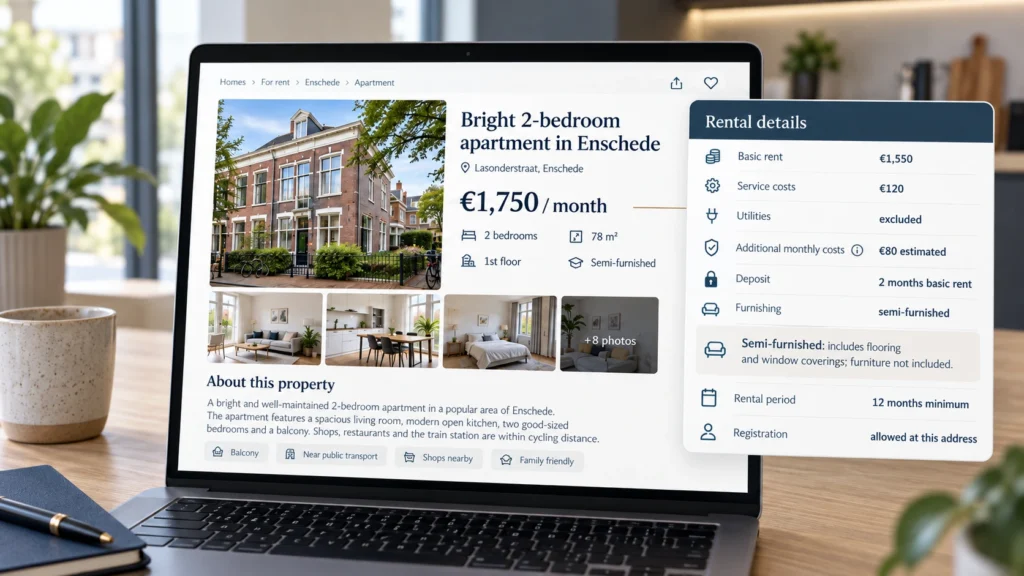
You find an apartment for €1,750 per month. Perfectly within budget.
Or is it?
When reading a Dutch rental listing, check what is actually included in the advertised price. The basic rent may be separate from service costs, utilities or other monthly charges.
Also pay attention to:
- the deposit
- whether the property is furnished or semi-furnished
- the rental period
- whether registration at the address is possible
- any additional monthly costs
Dutch rental listings may use words such as gestoffeerd and gemeubileerd. A semi-furnished property may include flooring and window coverings, for example, without including the furniture you would expect from a fully furnished home.
The headline price is therefore only one part of the picture.
Step 6: Be ready for the viewing and application
A viewing is your chance to see whether the home actually matches the listing.
Look beyond whether you like the kitchen or sofa. Pay attention to the condition of the property, natural light, storage, the neighbourhood and practical things such as parking or public transport.
Still abroad? It can be worth asking whether a video viewing or another form of remote viewing is possible.
If you decide to apply afterwards, being prepared helps. In popular parts of the rental market, several candidates may be interested in the same property.
That is when having your wishes and documents ready becomes especially useful.
Step 7: Check before you sign
Getting offered a home is exciting, especially after a long search.
Still, this is not the moment to skip the small print.
Check the rent, additional costs, deposit, starting date and rental period carefully. Also look at what is included with the property and what the agreement says about ending the tenancy.
If anything is unclear, ask before you sign.
It is much easier to sort out questions while you are still reading the contract than once the moving boxes are already inside.
Step 8: Do not forget registration after your move
Keys collected, boxes everywhere, first trip to the supermarket completed.
Almost there.
If you are moving to the Netherlands for a longer period, registering with your municipality is usually one of the important next steps. This is also how you receive your BSN, or citizen service number, which you will need for many practical parts of living in the Netherlands.
It may not be the most exciting part of the move, but it is one you do not want to forget.
There is no single best way to rent in the Netherlands
The general process of renting a home in the Netherlands as an expat may look similar for most people: decide what you need, understand the market, prepare your documents, search, view, apply and sign.
But the route between those steps can be very different.
Your budget, salary, employment contract, preferred region, moving date and length of stay can all influence which options are realistic — and where it makes sense to spend your time searching.
That is why a good rental search does not necessarily start with finding as many properties as possible.
It starts with understanding your own rental situation.

-

Living in the Dutch Countryside: Why Expats Can Find Better Value Beyond Amsterdam
When people think about moving to the Netherlands, Amsterdam is usually the first place that comes to mind. Canals, bicycles, beautiful townhouses, international companies — it is an easy picture to sell.
But if you are planning to move to the Netherlands for work, Amsterdam does not have to be the automatic answer.
The Netherlands is small, well connected and more varied than many newcomers expect. Outside the capital, you will find regional cities, residential neighbourhoods and smaller towns where shops, restaurants, employers and nature are often surprisingly close together.
In other words: looking beyond Amsterdam does not mean moving to the middle of nowhere.
Why look beyond Amsterdam?
Amsterdam has obvious advantages. It is international, lively and packed with things to do. For many expats, it can also feel like the easiest place to start.
The downside? Plenty of other people have the same idea.
Housing in the Netherlands is competitive, particularly in popular cities. Looking elsewhere will not magically make the Dutch housing shortage disappear, but widening your search can give you access to different neighbourhoods, housing types and price ranges.
You may discover that your budget stretches further outside the most popular areas. Or that a smaller city gives you the extra bedroom, garden or parking space that you would have to give up elsewhere.
And when you are relocating internationally, having more options is rarely a bad thing.
The Dutch countryside is closer than you think
The Dutch countryside can sound slightly dramatic when you are moving from abroad: endless fields, a lonely farmhouse and six cows as your closest neighbours.
In reality, many parts of the Netherlands blur the line between city and countryside.
You can live in a modern residential neighbourhood, cycle ten minutes and suddenly find yourself surrounded by fields or forests. Smaller towns often sit close to larger cities, while trains, buses and motorways connect much of the country.
Take Twente in the east of the Netherlands. Cities such as Enschede and Hengelo offer shops, restaurants, universities, hospitals and international employers, while smaller towns and green surroundings are never far away.
The same principle applies elsewhere. Around Eindhoven, for example, you can look beyond the city itself towards surrounding places such as Veldhoven. Arnhem and Nijmegen are surrounded by smaller communities and nature, while still offering the facilities you would expect from a city.
The point is not that one of these places is automatically better.
It is that your search does not have to stop at the city border.
Start with your workplace, not with Amsterdam
If you are moving to the Netherlands for work, try turning the usual search process around.
Instead of asking:
“Which Dutch city would I like to live in?”
Start with:
“Where do I actually need to be on a normal Tuesday morning?”
It sounds less exciting, but it is probably the more useful question.
If your office is in Eindhoven, Hengelo, Arnhem or Rotterdam, living in Amsterdam simply because it is the city you know best may add an unnecessary commute and limit your housing options.
Look at the area around your workplace first. Then gradually increase your search radius.
If you work hybrid, you may have even more freedom. A 40-minute journey twice a week feels very different from making that same journey five days a week.
And do not only look at kilometres. Check the actual journey. A town with a direct train connection may be more convenient than a neighbourhood that looks closer on the map but requires several transfers.
Where to live in the Netherlands: think in regions
One of the easiest mistakes when deciding where to live in the Netherlands is comparing only the country’s most famous cities.
Instead, think in regions.
Working in Eindhoven? Look at Eindhoven, but also at the surrounding towns and residential areas.
Working in Twente? Compare Enschede and Hengelo with nearby towns such as Borne or Oldenzaal.
Working somewhere between Arnhem and Nijmegen? Both cities — and the places between them — could be worth considering.
This gives you a much more realistic picture of your options.
It also helps you choose based on your actual lifestyle. Someone who wants restaurants within walking distance will search differently from someone who dreams of a garden, home office and quiet street.
Before choosing an area, compare these five things:
- Commute: How long does the journey to work actually take during the times you will travel?
- Budget: What type and size of home can you realistically rent there?
- Transport: Do you need a car, or can you rely on trains, buses and a bicycle?
- Daily life: Are supermarkets, gyms, cafés and other facilities nearby?
- Space: How important are an extra bedroom, garden, balcony, parking space or home office?
A location that scores well on the things that matter to you is much more useful than simply choosing the city with the most recognisable name.
What does your Dutch rent actually get you?
When comparing locations, do not only look at the number next to the word rent.
Look at what you actually get for it.
The same budget may get you a smaller apartment in a popular city or a larger home somewhere else. Depending on the location, widening your search may also give you access to properties with outdoor space, parking or an extra bedroom.
That can be especially valuable if you work from home.
There is another reason to look beyond the advertised monthly price. When renting in the Netherlands, you will come across terms and costs that may work differently from what you are used to.
Listings may describe a property as furnished, upholstered or unfurnished. Service costs can be charged separately and utilities are not always included. Landlords may also ask for proof of income, employment documents and a deposit before approving a tenant.
So two properties with the same advertised Dutch rent can result in very different monthly costs — and very different lifestyles.
Before you fall in love with the sunny balcony, check the boring details too.
City, regional city or smaller town?
There is no one correct answer.
A large city can be ideal if nightlife, restaurants, international communities and having everything nearby are important to you. The trade-off may be stronger competition or less space for your budget.
A regional city can offer a comfortable middle ground: plenty of shops, cafés, culture and public transport, while giving you access to a wider range of residential neighbourhoods.
A smaller town may suit you better if you prefer quieter surroundings, parking, greenery or more space at home. The main question is whether your commute and daily routine still work.
That is why the most useful question is not:
“Is this place exciting enough?”
It is:
“Would my everyday life work here?”
Because after a few months, the distance to your office, supermarket or favourite gym will probably matter more than whether tourists recognise the name of your town.
Look at your whole life, not just the house
Finding a beautiful property is only part of choosing where to live in the Netherlands.
Think one step further.
Can you register at the address? How will you get to work? Is there a train station nearby? If you travel internationally, how easy is it to reach an airport? If your partner is relocating with you, does the location work for both careers?
Your plans also matter.
Someone coming to the Netherlands alone for a one-year assignment may prioritise a furnished apartment and short commute. A couple planning to stay longer may care much more about an extra bedroom, neighbourhood, garden or space to work from home.
There is no universal formula.
A useful starting point is:
workplace + budget + lifestyle + transport + housing preferences
That combination will usually tell you much more than a list of the “best cities for expats”.
Look beyond the obvious
Moving to the Netherlands is already a big decision. Choosing where to live should not be based only on the Dutch cities you happened to know before you arrived.
Amsterdam may still turn out to be exactly right for you.
But it is worth zooming out first.
A regional city could put you closer to work. A smaller town could give you the extra room you wanted. A neighbourhood on the edge of the countryside could mean cycling into the city while still having nature around the corner.
So before refreshing the same Amsterdam rental listings for the hundredth time, open the map and look a little further.
Your ideal place to live in the Netherlands might be somewhere you had never thought to search.